New Type Of Accelerometer With 100 Times More Sensitivity and 10 Times Circuit Diagram An accelerometer is a device that measures acceleration, which is the rate of change in the velocity of an object. Accelerometers are commonly used in a variety of applications, including inertial navigation systems, automobile airbag deployment, vibration monitoring and analysis, motion-activated games and devices, and pedometers. They are essential tools for detecting and measuring motion An accelerometer is a sensor that measures acceleration forces, such as gravity and motion, by detecting changes in capacitance or utilizing the piezoelectric effect. Accelerometers provide real-time data on motion, orientation, and vibration, enabling applications such as motion detection, vehicle stability control, and structural health

To achieve this level of precision, one commonly used sensor is the accelerometer. In this comprehensive guide, we will delve into how accelerometers work and provide a step-by-step approach to measuring position using these versatile devices across various applications. Understanding Accelerometers: 1. What is an accelerometer? An accelerometer is a transducer that measures vibration by detecting the acceleration of motion in a structure.It converts the vibration into a proportional electrical signal, following Newton's Second Law of Motion, which states that acceleration (m/s²) is directly proportional to the net force (Newton) acting on a body and inversely proportional to its mass (kilograms). A triaxial accelerometer houses three sensing elements, oriented perpendicular to each other. They find their use in measuring building vibrations, turbines, and high-speed machinery. Key Applications of Accelerometers. Accelerometers find their purpose in many industrial, manufacturing, commercial, and laboratory applications.
Measure Position With Accelerometer: A Comprehensive Guide Circuit Diagram
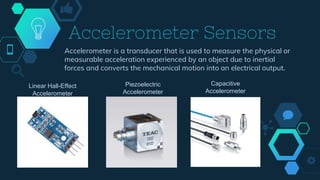
Accelerometers are designed using different methods. Piezoelectric, piezoresistive and capacitive components are generally used to convert the mechanical motion caused in accelerometer into an electrical signal. Piezoelectric accelerometers are made up of single crystals. These use the piezoelectric effect to measure the acceleration. Everyday Applications of Accelerometer Sensors Use in Mobile Devices. This processed data is then often used to measure, in various applications, from simple tilt detection to complex motion tracking. Understanding sensor output also involves knowing how to interpret changes in acceleration, which can indicate different types of direction An accelerometer sensor is a device that measures the acceleration forces acting upon it. These forces can be static, such as gravity, or dynamic, caused by movement or vibrations. accelerometers are used in a variety of applications. Smartphones use accelerometers for orientation detection, enabling features like auto-rotation and motion

In contrast, Epson's quartz microfabrication technology results in accelerometers that are more accurate, stable, and capable of handling a wider range of applications. How to use Epson's accelerometer sensors. The basic procedure for using Epson's A352 accelerometer (evaluated via PC connection) is as follows:
